Book your place the next Community Conversations webinar: Think Like a Non-Human
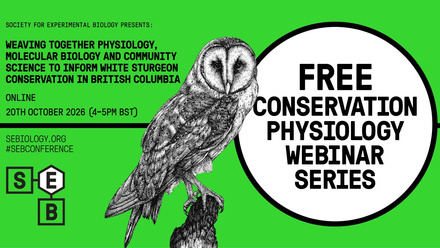
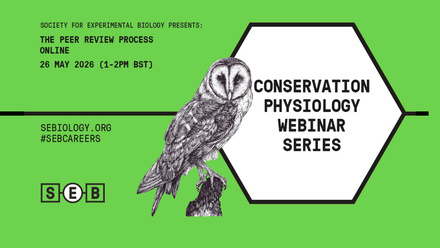
BOOK YOUR PLACE FOR THE NEW CONSERVATION PHYSIOLOGY WEBINAR SERIES
Dear members,
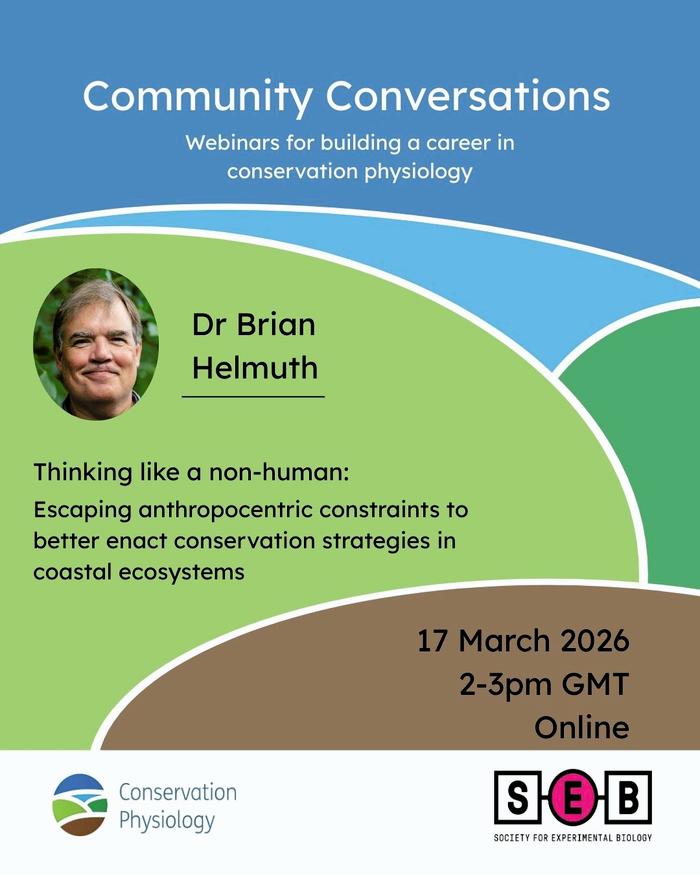
Join us on 17 March 2026 at 2 PM (UK time) for the upcoming Community Conversations webinar from Conservation Physiology and the Society for Experimental Biology, with Prof. Brian Helmuth exploring how thinking beyond anthropocentrism can transform coastal conservation strategies.
As humans, we view the world in ways that are fundamentally at odds with how the vast majority of nonhuman organisms experience the same conditions, a consequence of anthropocentrism (centering one’s perception of the natural world on humans). Weather and oceanographic conditions that we perceive as benign can in fact expose some animals and plants to extreme conditions, and vice versa. This not only affects our ability to effectively design and implement experiments in the field and lab to understand how climate change affects marine organisms, but can also influence decision making of how we use that information to implement conservation strategies. It also affects how we teach environmental science to students.
Using a cognitive science approach centered on understanding perceptions of nature and in particular marine environments, I’ll discuss ways that we can “think like a non-human” both in the classroom and while designing conservation measures. Having lived underwater for multiple days as an Aquanaut using a technique called saturation diving, I’ll also explore how literally living as part of an ocean ecosystem can help to foster new understandings of the human-ocean connection. I’ll discuss plans for ProteusTM, the vision of Fabien Cousteau where we are building the world’s largest saturation diving facility to address the ocean’s most pressing challenges.
You will need to create and/or log into your SEB account to be able to book this event.
Once you register, you will be sent the Zoom link and joining details 1 day before the event.
There is an opportunity on the booking form to let us know if you have any accessibility requirements so we can help everyone to engage and access this webinar.
Join the Conservation Physiology special interest group!
Already a member of SEB? If you're interested in this webinar, you should join the Conservation Physiology special interest group (SIG)!
The field of conservation physiology explores the physiological responses of organisms to anthropogenic -induced environmental change and attempts to determine the possible threats imposed by current and future conditions. This group brings together physiologists, ecologists and conservation biologists together that have an interest in studies that are assessing and predicting the impacts of current and future human-induced environmental change on organisms.
We very much look forward to seeing you there.
Best regards,
The SEB Team