
August 2026 TPJ Editor choice: Stem cell killer: cyclin-dependent kinase inhibitor KRP6 eliminates DNA-damaged stem cells
Research highlight for Wada et al. (2026): The cyclin-dependent kinase inhibitor KIP-RELATED PROTEIN 6 promotes stem cell death upon DNA damage in Arabidopsis roots
Stem cell killer: cyclin-dependent kinase inhibitor KRP6 eliminates DNA-damaged stem cells
Plants seem to thrive on a sunny day. Yet even in seemingly idyllic conditions, they are continuously exposed to environmental genotoxic stressors like ultraviolet light that can directly damage DNA and cause mutations that ultimately threaten genome integrity. To maintain genomic stability throughout development, plants rely on a suite of cellular defence mechanisms against DNA damage, including dedicated repair pathways and cell cycle arrest. These safeguards are particularly important in meristems, where mutations arising in a single stem cell can easily propagate into newly developing tissues. Consequently, stem cells are equipped with particularly robust systems to detect, repair and even eliminate damaged cells via programmed cell death to ensure the proper formation of new organs. Such responses are tightly coupled to the cell cycle, where DNA integrity is assessed at specific checkpoints to ensure that damage can be repaired before cell division proceeds. Central players in the crosstalk between these two processes include cyclin-dependent kinases (CDKs) - the core drivers of cell division - and CDK inhibitors (CKIs). Upon DNA damage, CKI genes are activated by the master transcription factor SUPPRESSOR OF GAMMA RESPONSE 1 (SOG1), leading to CDK inhibition and ultimately cell cycle arrest.
Having previously characterised the functions of SOG1, Naoki Takahashi at Meiji University teamed up with long-term collaborator Masaaki Umeda at NAIST (Ikoma) and Ayako Sakamoto at QST (Takasaki) in a new study to elucidate the interplay between DNA damage signalling and the cell cycle (Wada et al., 2026).
DNA damage in the form of double-strand breaks (DSBs) can be triggered experimentally using the radiomimetic agent zeocin. In Arabidopsis, zeocin significantly induced several CKI genes including KRP6, a member of the Kip-related proteins/interactors of CDK (KRPs/ICKs) family. KRPs are primarily associated with developmental processes and their putative role in the DNA damage response had not been described previously. To investigate the tissue specificity of KRP6 expression, the authors generated transgenic plants expressing a pKRP6:GFP transcriptional reporter. Following 10 hours of treatment with zeocin, GFP accumulated in the stem cell niche, while the intensity of fluorescence and the number of GFP-positive cells increased considerably with longer treatments. A KRP6-GFP fusion protein expressed from the KRP6 promoter also accumulated in this region following zeocin treatment.
The dynamic induction of KRP6 in the stem cell niche raises the question about how its transcription is regulated. Zeocin failed to induce KRP6 in a sog1-101 knock-out mutant line, indicating that this upregulation is dependent on SOG1. Chromatin immunoprecipitation (ChIP) assays later confirmed that a SOG1-Myc fusion protein binds upstream of KRP6 upon zeocin treatment.
To better understand the physiological functions of KRP6, the authors next characterised krp6-1 mutant plants. Zeocin-induced stem cell death was dramatically reduced in krp6-1 (Figure 1), while complementation with pKRP6:KRP6-GFP restored this response to wild-type levels. By contrast, zeocin-induced stem cell death was strongly increased in two independent 35S:KRP6 overexpression lines. Together, these results strongly support the conclusion that KRP6 promotes DNA damage-induced stem cell death.
Plants are constantly bombarded by genotoxic agents that directly damage DNA and threaten their genome stability. As natural environments become more extreme in the face of climate change, these stresses are set to become even more severe. Takahashi believes that greater understanding of the strategies used by plants to sense and overcome DNA damage can ultimately translate into improved stress resilience and long-term yield security in crops facing increasingly unpredictable environmental conditions.
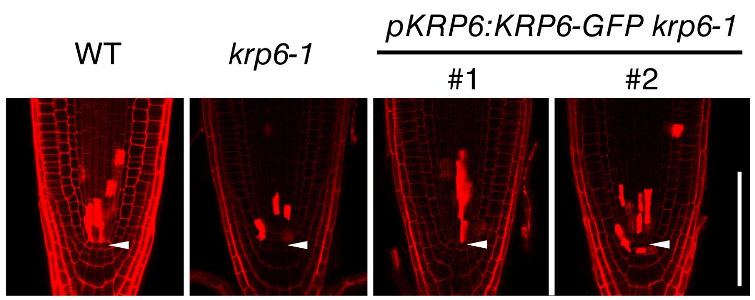
Figure 1. DNA damage-induced stem cell death is suppressed in the krp6 mutant.
Root tips of Arabidopsis seedlings after treatment with the DNA damage-inducing agent zeocin. Five-day-old wild-type (WT), krp6-1 and two independent pKRP6:KRP6-GFP krp6-1 (#1 and #2) seedlings were treated with 10 μM zeocin for 24 hours before dead cells were stained with propidium iodide.
Arrowheads indicate the quiescent centre stem cell niche. Bar = 100 μm. Figure adapted from Wada et al. (2026).
References
Wada, T., Sakamoto, A. N., Umeda, M., & Takahashi, N. (2026). The cyclin-dependent kinase inhibitor KIP-RELATED PROTEIN 6 promotes stem cell death upon DNA damage in Arabidopsis roots. The Plant Journal, 126, e70964.