
July 2026 TPJ Editor choice: A clean slate for Rubisco engineering
Research Highlight on: da Silva G.E., Obst S., Carvalho P., Forner J., Ruf S., Saibo N.J.M. & Bock R. (2026) Generation of a recipient line for Rubisco engineering by multiplex genome editing in tobacco. The Plant Journal, 126(4), e70930.
A clean slate for Rubisco engineering
Few enzymes carry as much responsibility, or as much blame, as Rubisco. As the gateway for carbon into the Calvin–Benson–Bassham cycle, it underpins virtually all life on Earth and, at an estimated 0.7 gigatons, is the most abundant protein on the planet. Yet Rubisco is a mediocre catalyst: it often fixes oxygen instead of carbon dioxide, triggering wasteful photorespiration, making it a longstanding target for those hoping to lift crop yields by redesigning carbon fixation at its source.
Rubisco is a hexadecamer of eight large subunits, encoded by the chloroplast rbcL gene, and eight small subunits from a nuclear RbcS gene family, regulated by Rubisco activase, a nuclear-encoded AAA+ ATPase. These co-evolved components, the 'Rubiscosome', resist being mixed across species: introduce a foreign large subunit and the host's own small subunits still assemble into chimeric, often dysfunctional holoenzymes. Decades of engineering have foundered on this incompatibility.
In this issue, da Silva et al. (2026) take a radical approach: rather than substituting components one at a time into a background of competing native parts, they remove those parts altogether. Using multiplex CRISPR-Cas9 in the diploid tobacco Nicotiana sylvestris, they knocked out all six photosynthetic RbcS loci and all three Rca loci, generating a recipient line, Nsyl-RL, that lacks a functional Rubisco system and requires exogenous sucrose to grow (Figure 1).
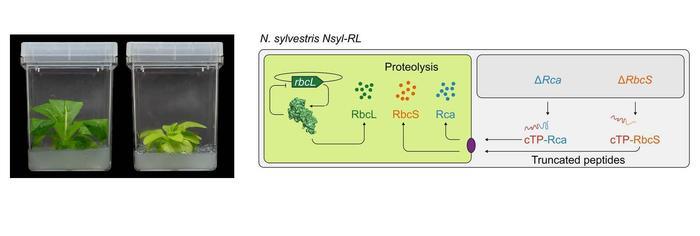
Figure 1. Wild-type Nicotiana sylvestris (left, no sucrose) and the recipient line Nsyl-RL (right) in vitro; lacking a functional Rubisco system, Nsyl-RL is chlorotic and sucrose-dependent. With RbcS and Rca knocked out (schematic), truncated proteins are degraded, and the plastid-encoded large subunit (RbcL) cannot accumulate without RbcS, so no Rubisco or activase forms. Adapted from da Silva et al. (2026).
"Just engineering a single component of the system bears a high risk of causing incompatibilities," explains Ralph Bock, the study's corresponding author. "We reasoned that the best way to avoid this risk is to produce a 'clean slate' to be able to replace the entire Rubisco system." Tellingly, he frames the work as more than a Rubisco story: "We think this strategy could be a blueprint for other multi-subunit protein complexes whose components have co-evolved."
Sequencing and immunoblots confirmed Nsyl-RL lacks intact RbcS and Rca alleles and accumulates neither RbcS, Rca nor RbcL protein. Strikingly, the large subunit is absent even though rbcL remains intact in the plastid genome: lacking a small-subunit partner, RbcL is rapidly degraded, confirming the mutual dependence of the two subunits. The plants are pale and stunted, sucrose-dependent, and cannot flower unaided.
The significance lies in what can now be built on that blank canvas: transferring a superior natural Rubisco from another seed plant. Bock points to sunflower, whose Rubisco has higher relative specificity for CO₂ than tobacco's; its small subunits and activase could be supplied by nuclear transformation, and its large subunit by plastid transformation, replacing the resident rbcL rather than allowing mixed holoenzymes to form. Engineering alone is unlikely to raise yield by much more than 10%, Bock cautions, so larger gains will likely need photorespiratory bypasses or synthetic carbon-fixation cycles alongside it.
Because Nsyl-RL cannot photosynthesise or flower unaided, it must be grafted onto wild-type rootstock to set seed. There is a paradox at the heart of the achievement: to build a better photosynthetic enzyme, the authors first had to make a plant that cannot photosynthesise at all. That empty vessel is the point, allowing heterologous and synthetic Rubisco systems to be installed and compared side by side in an identical background.
Quotations from Ralph Bock are taken from a written interview conducted for TPJ Research Highlight and are reproduced with permission.