
May 2026 TPJ Editor choice: From orphan to global player: what 10,617 cowpea accessions reveal about geographic structure
Highlighted publication:
Scaling up orphan crop research: genebank genetics highlight geographic structure in cultivated cowpea from 10 617 global accessions
From orphan to global player: what 10,617 cowpea accessions reveal about geographic structure
So-called orphan crops, which have received little attention by the global scientific community, play crucial roles for food security and livelihoods in many low-income countries. Although their productivity is often lower in high-input agricultural systems, reflecting limited historical investment in breeding and genetic improvement, they possess valuable characteristics such as resilience to harsh climates and high nutritional value. They also represent important reservoirs of genetic diversity for crop improvement.
Cowpea is one such orphan crop. Domesticated in Africa, it is widely cultivated for human consumption across the semi-arid tropics of Africa, Asia and Latin America. Compared with major legumes such as soybean, common bean and chickpea, however, breeding efforts have remained limited. In recent years, cowpea has garnered increasing attention because it can improve soil fertility when intercropped with cereals through biological nitrogen fixation. Its susceptibility to pests and diseases nevertheless remains a major limiting factor, highlighting the need for further crop improvement.
Breeding programmes typically rely on diverse genetic resources such as landraces, elite lines and wild relatives, which can be provided by diversity collections. Collections are defined sets of accessions – often grouped by species, geographic origin or project – and are conserved in genebanks. In the highlighted publication, Pearson et al. explored the genetic diversity and population structure of 10,617 cowpea accessions from seven collections, representing 121 countries and approximately 23 % of global cowpea diversity. Most accessions belonged to the unguiculata cultivar group, which is widely cultivated as a pulse or vegetable crop. To generate genotypic data, the authors relied on reduced-representation sequencing, a cost-effective method that sequences only part of the genome; while this results in lower marker density compared with whole-genome sequencing, it enables analysis of genetic variation across a very large number of samples.
Through pairwise identity-by-descent (IBD) analysis, which identifies identical genomic regions between two individuals inherited from a common ancestor, the authors detected closely related accessions and potential duplicates. After removing redundancy, they identified 9,609 unique accessions that could be divided into 9 genetic groups, four of which exhibited significant geographic associations: Group 2 in Africa, Group 3 in Asia and Oceania, Group 6 in Europe and Group 7 in South America (Fig. 1). Analysis of molecular variance revealed that genetic diversity was unevenly distributed across these groups: some contained unique and potentially underutilised variation, while others showed higher levels of relatedness or redundancy.
Earlier studies had suggested that cowpea diversity carries a geographic “footprint” linked to historical dispersal from West and East Africa. Pearson et al. broadly confirmed this pattern: the two major genetic clusters identified in their analyses reflected a long-standing geographic separation of cowpea diversity. Surprisingly, however, the study also showed that sub-Saharan Africa does not contain the full extent of global cowpea variation. Substantial additional diversity was detected in Asia and the Americas, highlighting potentially valuable genetic resources outside the traditionally recognised centre of diversity.
Overall, the study by Pearson et al. identified substantial duplication within and across collections that inflates curation costs and risks unintentional reselection of identical accessions by users.
The authors therefore emphasise the need for improved curation practices supported by comprehensive pedigree, passport and standardized trait metadata to enhance the value and usability of conserved germplasm.
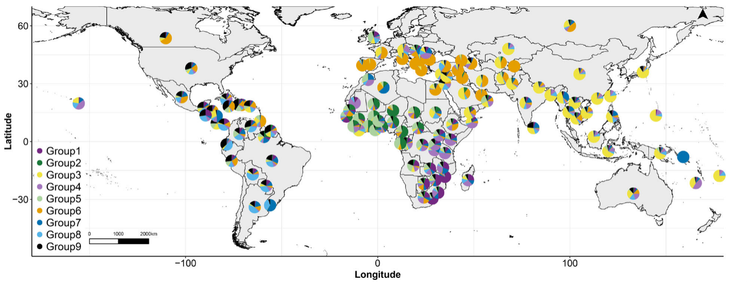
Figure 1: Geographic distribution of the non-redundant global cowpea collection.
The proportion of genetic groups in the respective country is represented by colours.