November 2026 TPJ Editor choice: Lessons from the past: Resurrecting an ancestral strigolactone receptor
Research Highlight for ‘Structural and functional characterisation of a reconstructed ancestral strigolactone receptor’
Lessons from the past: Resurrecting an ancestral strigolactone receptor
Plants use an array of phytohormones to coordinate their growth and communicate with the organisms around them. Strigolactones (SLs) are a class of butenolide phytohormones with a wide range of physiological roles. First identified as root exudates that could stimulate the germination of parasitic Striga plants, they were later found to promote symbioses with arbuscular mycorrhizal fungi and root bacteria. Within the plant, SLs regulate several aspects of development, most notably by suppressing shoot branching.
In seed plants, SLs are perceived by DWARF14 (D14), which acts as both a receptor and an α/β-hydrolase enzyme. D14 binds SLs within a hydrophobic pocket and hydrolyses them using a catalytic triad of serine, aspartate and histidine residues. Ligand perception also triggers a conformational change that enables D14 to interact with the F-box protein MORE AXILLARY GROWTH 2 (MAX2), leading to the degradation of SUPPRESSOR OF MAX2-LIKE/DWARF 53 (SMXL/D53) transcriptional repressors and induction of SL-responsive genes. Intriguingly, however, the relationship between the enzymatic and signalling functions of D14 remains unresolved.
D14 belongs to a larger family of related α/β-hydrolases that includes KARRIKIN INSENSITIVE 2 (KAI2). KAI2 is a receptor for karrikins, plant growth regulators that structurally resemble SLs and are found in the smoke from burning plants. KAI2 homologues are found throughout land plants and algae, whereas D14 is restricted to seed plants, suggesting that D14 evolved following duplication and neofunctionalisation of an ancestral KAI2-like protein. Although modern KAI2 and D14 proteins share structural and mechanistic similarities, they have distinct ligand preferences and cannot substitute for one another in Arabidopsis. How and when D14 acquired the characteristics of a specialised SL receptor thus remains an intriguing evolutionary question.
Associate Professor Mark Waters at The University of Western Australia first became interested in SL perception through his group’s work on karrikins. In particular, the group were curious about the evolutionary changes that led to the distinct activities of KAI2 and D14. Waters wondered whether an early D14 present at the origin of seed plants might retain KAI2-like characteristics, potentially revealing an intermediate stage in the transition from ancestor to a modern SL receptor. In their new study, Waters and colleagues travelled back along this evolutionary trajectory using ancestral sequence reconstruction (ASR) (Tuckey et al., 2026). ASR uses phylogenetic relationships between modern proteins to infer sequences that may have existed in their common ancestors. The team reconstructed ancD14, a protein representing the ancestor of D14 orthologues from angiosperms and gymnosperms (clade eu-D14) as well as a minor sister taxon unique to conifers (termed DLK4) (Figure 1A).
To test the activity of the ancestral protein, Tuckey et al. (2026) expressed ancD14 in an Arabidopsis kai2 d14 double mutant. AncD14 rescued phenotypes caused by the absence of D14, including increased shoot branching and reduced plant height (Figure 1B). Contrastingly, a delayed flowering phenotype attributed to the kai2 mutation was not rescued by ancD14. Similarly, ancD14 restored the response to the synthetic SL analogue rac-GR24, but not to the desmethyl compound rac-dGR24 preferred by KAI2. Rather than exhibiting the anticipated mixture of KAI2- and D14-like properties, the ancestral protein instead behaved more like the bona fide SL receptor.
To characterise the structural basis for this activity, Tuckey et al. (2026) determined the crystal structure of ancD14 at 1.95 Å resolution. While the overall architecture closely resembled modern D14 (Figure 1C-E), the ancD14 active site contained some unexpected features. The catalytic serine and histidine were positioned closer together, and the orientation of the catalytic serine was more characteristic of KAI2. These findings suggest that SL perception can tolerate considerable variation in the configuration of the D14 active site, and further indicate that interactions with downstream signalling partners may have been of primary importance during the functional specialisation of D14.
Somewhat unexpectedly, the ancestral receptor also delivered some practical advantages. AncD14 exhibited increased thermostability and more than twice the recombinant protein yield compared with Arabidopsis D14. Waters believes that these properties mean that ancD14 could be deployed as a robust biosensor for SLs. The group is already extending the ASR approach to KAI2, where ancestral variants are being developed as molecular probes for karrikin-like compounds in plants.
Together, these findings suggest that the core identity of D14 as an SL receptor was already established around the emergence of seed plants. Despite altered enzyme kinetics and unusual active-site geometry, ancD14 already featured the ligand specificity, signalling activity and mechanistic characteristics of its modern descendants. At the same time, its exceptional stability and tractability demonstrate that looking backwards through protein evolution can reveal new paths forward for biological discovery and protein engineering.
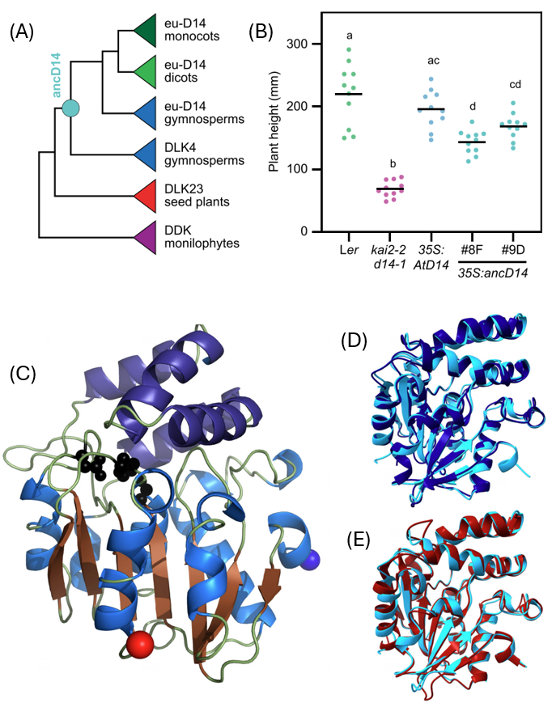
Figure 1. Structure and function of ancD14. A. AncD14 was designed to represent the ancestor of eu-D14 and DLK4 sequences from seed plants. Simplified cladogram based on maximum likelihood phylogeny. B. Plant height measured 18 days after flowering in kai2 d14 mutants complemented with AtD14 and ancD14. C. Cartoon representation of ancD14 coloured by secondary structure. The catalytic triad is represented by black balls-and-sticks. N- and C-termini are represented as blue and red spheres, respectively. D. Structural alignment of ancD14 and AtD14 (Protein Data Bank entry: 4IH4); root mean square deviation of atomic positions (RMSD) = 0.896 Å. E. Structural alignment of ancD14 and AtKAI2 (Protein Data Bank entry: 4HRX); RMSD = 0.727 Å. Figure adapted from Tuckey et al. (2026).