
March 2026 TPJ Editor choice: Peptide protection: A small secreted peptide confers drought tolerance in cotton
Research Highlight for https://onlinelibrary.wiley.com/doi/10.1111/tpj.70652):
Peptide protection: A small secreted peptide confers drought tolerance in cotton
Intercellular communication enables environmental cues perceived by a single cell to be relayed and propagated to its neighbours. This communication is largely mediated by the secretion of signalling molecules into the extracellular space or ‘apoplast’. Small secreted peptides (SSPs) are a class of extracellular signalling molecules emerging as major regulators of a variety of essential biological processes, including growth and stress tolerance. SSPs are typically synthesized as larger precursor proteins that are secreted into the apoplast before a mature bioactive peptide is released by extracellular proteases. Such cleavage events are difficult to predict and may result in short, low-abundance peptides. Together, these factors have hindered the systematic identification and characterisation of novel SSPs.
In their recent study, researchers from the groups of Fei Xiao and Zuoren Yang based in Xinjiang, China sought to elucidate the roles of SSPs in cotton, the world’s most widely used natural fibre. Xinjiang is responsible for over 20% of global cotton production and ensuring that yields continue to sustain global demand is a key priority for scientists in the region. The most widely cultivated species is the high-yielding Gossypium hirsutum (upland cotton), followed by G. barbadense (sea-island cotton), prized for its superior fibre quality. Both species can be vulnerable to drought, an enduring threat in the arid climate of Xinjiang.
In a recent study, Lu et al. (2026) constructed the first expression atlas of SSPs in cotton by filtering protein-coding sequences by size and predicted apoplastic localisation. Of the 2629 and 2331 putative SSPs genes identified in G. hirsutum and G. barbadense respectively, only 35% could be assigned to known SSP families, highlighting the limitations of current knowledge. As SSPs often play key roles in mediating stress responses in other plant species, the authors employed transcriptomic analyses to assess whether SSP gene expression in G. hirsutum was responsive to the environmental stresses of drought and salinity, among the most urgent threats facing cotton production.
Two SSP genes displayed a strong and sustained induction in response to both conditions, with Ghir_D08G44451 the most responsive to drought stress. Multiple orthologues of this previously uncharacterised gene were subsequently identified across four Gossypium species and assigned to a novel family designated GDRPs (Gossypium Drought and Salt Resistance Peptides). Multiple sequence alignment of GDRP proteins revealed the strict conservation of a 15-amino-acid C-terminal motif. The authors reasoned that this motif may represent the functional peptide domain following its release by apoplastic proteases. To test its activity, the predicted mature GDRP was chemically synthesized and sprayed onto G. hirsutum seedlings subjected to drought (Figure 1). GDRP-treated plants exhibited visibly enhanced drought tolerance with increased fresh weight, increased water retention via stomatal closure and reduced accumulation of stress-associated reactive oxygen species.
The striking impact of exogenous GDRP application implies the activation of signalling pathways that promote stress tolerance. Drought-induced phosphorylation of mitogen-activated protein kinases MPK3 and MPK6 was stronger when accompanied by GDRP application and the enhanced drought tolerance conferred by GDRP was lost upon virus-induced gene silencing of GhMPK3 and GhMPK6. These results strongly suggest that extracellular perception of GDRP enhances drought resistance by activating MPK3/6 signalling cascades, culminating in the expression of drought tolerance genes.
Together, these findings establish GDRPs as a novel, structurally conserved SSP family in cotton with the potential for exogenous application to protect yields in the face of increasingly frequent drought stress.
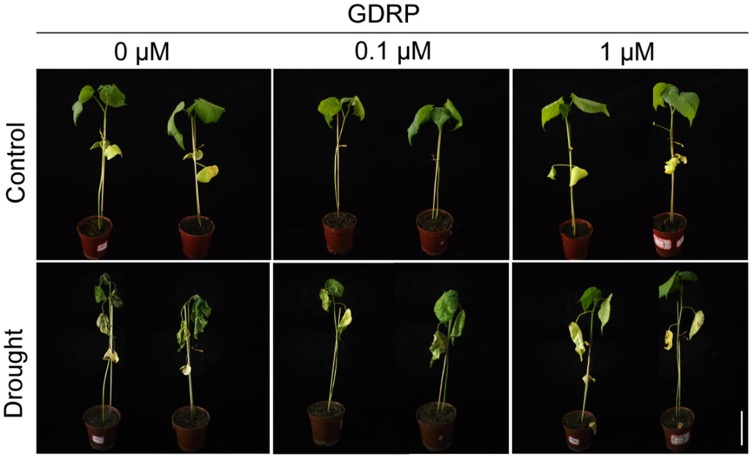
Figure 1. Exogenous GDRP application alleviates symptoms of drought stress in cotton.
G. hirsutum seedlings subjected to natural drought conditions were sprayed every 24 hours with 0, 0.1 or 1 μM GDRP. Figure modified from Lu et al. (2026).